


The US non-farm payrolls (NFP) report is released at 8:30 a.m. New York time. That is 15:30 in South Africa and Zambia and 16:30 in Kenya and Tanzania while the United States is on standard time, and one hour earlier on your clock while the US is on daylight saving. The next release, for November 2026 data, is on Friday 4 December 2026, at 15:30 SAST and 16:30 EAT.
This guide gives the release time in South African and East African time, the dates for the coming months, how the US clock change moves the time, what NFP is, and the risks of trading around the release.
NFP release time in South Africa, Zambia, Kenya and Tanzania
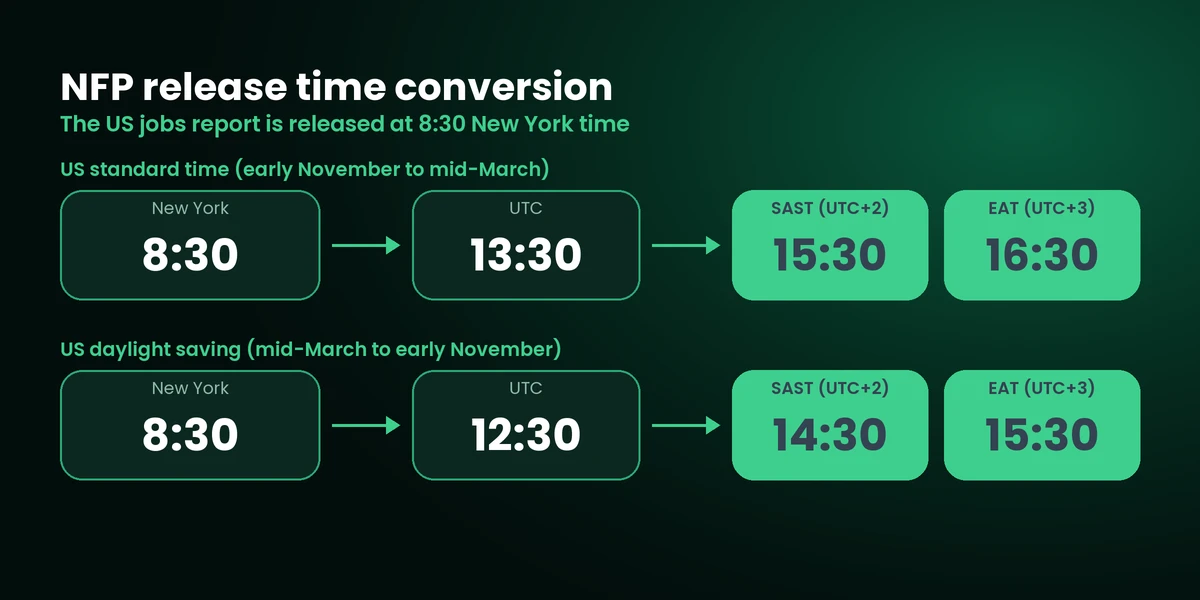
The US Bureau of Labor Statistics (BLS) publishes NFP as part of its Employment Situation report, at 8:30 a.m. Eastern Time (source: BLS). South Africa (SAST), Zambia (CAT), Kenya and Tanzania (EAT) do not use daylight saving, so only the US side changes.
Standard time (early November to mid-March) (8:30 New York: 8:30 EST; Universal time: 13:30; South Africa and Zambia (UTC+2): 15:30; Kenya and Tanzania (UTC+3): 16:30)
Daylight saving (mid-March to early November) (8:30 New York: 8:30 EDT; Universal time: 12:30; South Africa and Zambia (UTC+2): 14:30; Kenya and Tanzania (UTC+3): 15:30)
The SuperFin MT5 server also runs on UTC+2 in winter, so on that platform the release shows up at 15:30 server time. From Kenya or Tanzania, the platform clock is one hour behind your local time.
NFP dates for the coming months
The BLS has published these Employment Situation release dates (source: BLS release schedule, checked 11 November 2026):
November 2026 (Release date: Friday 4 December 2026; US clock: Standard; SAST / CAT: 15:30; EAT: 16:30)
December 2026 (Release date: Friday 8 January 2027; US clock: Standard; SAST / CAT: 15:30; EAT: 16:30)
January 2027 (Release date: Friday 5 February 2027; US clock: Standard; SAST / CAT: 15:30; EAT: 16:30)
February 2027 (Release date: Friday 5 March 2027; US clock: Standard; SAST / CAT: 15:30; EAT: 16:30)
March 2027 (Release date: Friday 2 April 2027; US clock: Daylight saving; SAST / CAT: 14:30; EAT: 15:30)
The 8 January date is the second Friday of the month, because the first Friday is 1 January. NFP does not always fall on the first Friday, so use the schedule instead of assuming. The BLS can also reschedule a release. Check the SuperFin economic calendar in the days before.
What happens when US clocks change
Daylight saving ends in the United States on 1 November 2026 and starts again on 14 March 2027. For NFP this means:
The 6 November 2026 release came after the clocks went back, so it was at 15:30 SAST and 16:30 EAT.
Releases from December 2026 to 5 March 2027 stay at 15:30 SAST and 16:30 EAT.
The 2 April 2027 release is the first one after the US moves to daylight saving, so it arrives an hour earlier: 14:30 SAST and 15:30 EAT.
Nothing changes in South Africa, Zambia, Kenya or Tanzania. The release is fixed to New York time, so your clock appears to move.
What NFP measures
Non-farm payrolls is the monthly change in the number of paid jobs in the US economy, excluding farm workers and a few other categories. The BLS builds it from a survey of employers. The same report includes the unemployment rate, which comes from a separate survey of households, and revisions to the two previous months (source: BLS Employment Situation).
Markets treat the report as a signal about the health of the US economy and about what the Federal Reserve may do with interest rates. For that reason it often moves the US dollar, bond yields and gold within minutes of the release. For the basics of gold prices, see What is XAUUSD?.
The headline number is compared with a market forecast. Traders watch the gap between the two, along with the revisions and the unemployment rate. The direction of the reaction is not predictable in advance, and the first move is sometimes reversed.
Risks of trading around NFP
NFP is one of the most volatile moments of the month, and the risks are specific:
Wider spreads. The spread on gold and on dollar pairs can widen sharply around the release, so a trade costs more to open and close.
Slippage. Orders can fill at a worse price than the one you set, and stop losses are not guaranteed to fill at your level.
Gaps and fast reversals. Price can jump between two quotes, and the first move may reverse.
Leverage limits and margin. SuperFin limits leverage to 1:200 from 3 minutes before to 3 minutes after major news on the affected products, per the applicable leverage policy. The margin for an open position can rise, and positions can be closed automatically if the account cannot cover it. SuperFin's policy does not name which products count as affected, so check before you rely on a particular instrument.
Time zone mistakes. After a US clock change, a calendar set to the old time can be an hour out. Confirm the local time of the release each month.
Many traders choose not to hold large positions through the release, or they keep position size small. That is a risk decision for each person, and nobody can promise a profit from trading the news.
A short routine for NFP day
Confirm the date and time on the economic calendar and in your own time zone.
Check your open positions and margin at least 30 minutes before.
Decide in advance whether you will trade or stay out, and set your stop loss and size before the release, not during it.
Expect the 1:200 limit from 3 minutes before the release.
Review afterwards. Compare the spread, the fill price and the result with what you planned.
If you trade gold, the hours when it can be traded are in gold trading hours in South Africa.
Frequently asked questions
What time is NFP in South Africa?
15:30 SAST while the US is on standard time (early November to mid-March), and 14:30 SAST during US daylight saving.
What time is NFP in Kenya?
16:30 EAT while the US is on standard time, and 15:30 EAT during US daylight saving. The same applies in Tanzania.
What time is NFP in Zambia?
The same as South Africa: 15:30 CAT in winter and 14:30 CAT in US summer.
When is the next NFP?
Friday 4 December 2026 at 8:30 New York time, which is 15:30 SAST and 16:30 EAT. Confirm it on the BLS site or the SuperFin economic calendar.
Is NFP always on the first Friday?
Usually, but not always. January 2027's report is on Friday 8 January.
Does NFP move gold?
It often does, because it shapes expectations for US interest rates and the dollar, both of which affect gold. The size and direction of the move vary from release to release.
Should I trade NFP?
That is your decision. Spreads, slippage and margin changes make it riskier than a normal trading hour, and you can lose more than you expect in a few minutes.
Summary
NFP is released at 8:30 New York time. In SAST and CAT that is 15:30 in US winter and 14:30 in US summer. In EAT it is 16:30 and 15:30.
The next releases are 4 December 2026, 8 January, 5 February and 5 March 2027 at 15:30 SAST / 16:30 EAT, then 2 April 2027 at 14:30 SAST / 15:30 EAT.
Spreads, slippage and the 1:200 leverage cap all matter around the release, and margin can rise.
Check the date and your local time on the economic calendar each month.
Risk warning: Trading CFDs on gold and currencies involves leverage and a high level of risk, and you can lose all the money you deposit. Trading around news releases carries extra risk from wide spreads and slippage. Dates and times in this article can change, and the examples are for information only. This article is for education only and is not investment advice. Legal information about SuperFin: see About us.
Author: Aisyah Rahman · Reviewer: James Ptaszek · Updated 11 November 2026. Release dates from the US Bureau of Labor Statistics schedule, checked 11 November 2026.